
Born to Die
Part VII: The Cross as the Axis of Redemption

“Where is God?” That is where I began. I did not inherit an untroubled or instinctive faith. I was not granted, from the beginning, the simple and childlike trust that Scripture praises and that Christ Himself holds up as exemplary. My path was not one of immediate confidence, but of revision, unlearning, and eventual surrender. What follows in this final article is not a departure from that path, but its culmination.
I came to the faith as a modern man, formed by modern assumptions. I trusted reason instinctively, not as a tool, but as an arbiter. I assumed that clarity belonged to the intellect and that whatever could not be resolved conceptually could be deferred, bracketed, or dismissed. My initial engagement with Christianity therefore began not with devotion but with interrogation. I examined Scripture as a text among texts, theology as a system among systems, and the Church as one historical institution among many. I did not yet understand that I was standing above the very thing that could judge me.
The first decisive rupture in that posture came through what Lutheran theology names conviction. Conviction is not persuasion. It is not being argued into agreement or impressed into admiration. Conviction is standing judged. It is the moment when the Law no longer functions as an abstract moral category but as a living word that addresses the self and renders it accountable before God.¹ It is the collapse of self-justification. One does not emerge from conviction reassured. One emerges exposed. I did not become aware that God existed. I became aware that I stood before Him.
Conviction, rightly understood, does not produce faith. It prepares for it by killing illusions. It strips away the modern confidence that one’s sincerity, intelligence, or moral seriousness might suffice. It reveals that reason, when enthroned rather than ordered, becomes another form of pride. In my case, the Holy Spirit did not bypass reason. He worked through it, turning it against itself, exposing its limits, and reordering it under a higher authority. This is not a universal path, nor is it a superior one. It is simply the path given to me.
From conviction flows justification, which must be defined precisely, because it is the heart of the Gospel and the point at which modern misunderstanding is most destructive. Justification is not a process. It is not an interior transformation. It is not God gradually making the sinner acceptable. It is God declaring the sinner righteous on account of Christ alone.² It is forensic, external, and complete. The righteousness that justifies does not arise from within me. It is alien. It belongs to Christ and is credited to me by faith. This is not a metaphor. It is the only ground on which peace with God can exist.
Here modern man stumbles again, because justification leaves no room for contribution. All works, even the best, even those done in love, always come up short if they are offered as grounds for standing before God. As a Lutheran, I understand this not as pessimism but as liberation. If salvation depended in any degree upon my performance, my conscience would never rest. Faith alone saves because Christ alone has acted.³
Baptism enters this reality not as symbol or emotional milestone, but as incorporation. Scripture speaks of baptism as participation in Christ’s death and resurrection.⁴ It is not my declaration of allegiance, but God’s act of claim. It does not rest on my understanding, sincerity, or intensity. It rests on God’s promise. For one such as myself, whose path passed through intellect rather than instinctive trust, baptism marked not the culmination of insight, but submission to a reality already accomplished outside of me.
From justification and baptism flows sanctification, which must also be named without confusion. Sanctification is real. It is necessary. It is the work of the Spirit conforming the believer to Christ. But it is never complete in this life, and it is never the ground of assurance.⁵ To confuse sanctification with justification is to reintroduce anxiety where Christ has promised peace. Growth in holiness follows faith. It does not produce it.
I am acutely aware that many are granted what I was not: a simple faith, a childlike trust that receives Christ without the long labor of deconstruction and reconstruction. Scripture does not demean this faith. It blesses it. Christ Himself declares that the Kingdom belongs to such as these.⁶ When I speak of “simple faith,” I do not mean naïve faith, nor inferior faith. I mean faith that trusts because it is given trust, not because it has reasoned its way through obstacles. My envy of such faith is not rhetorical. It is genuine.
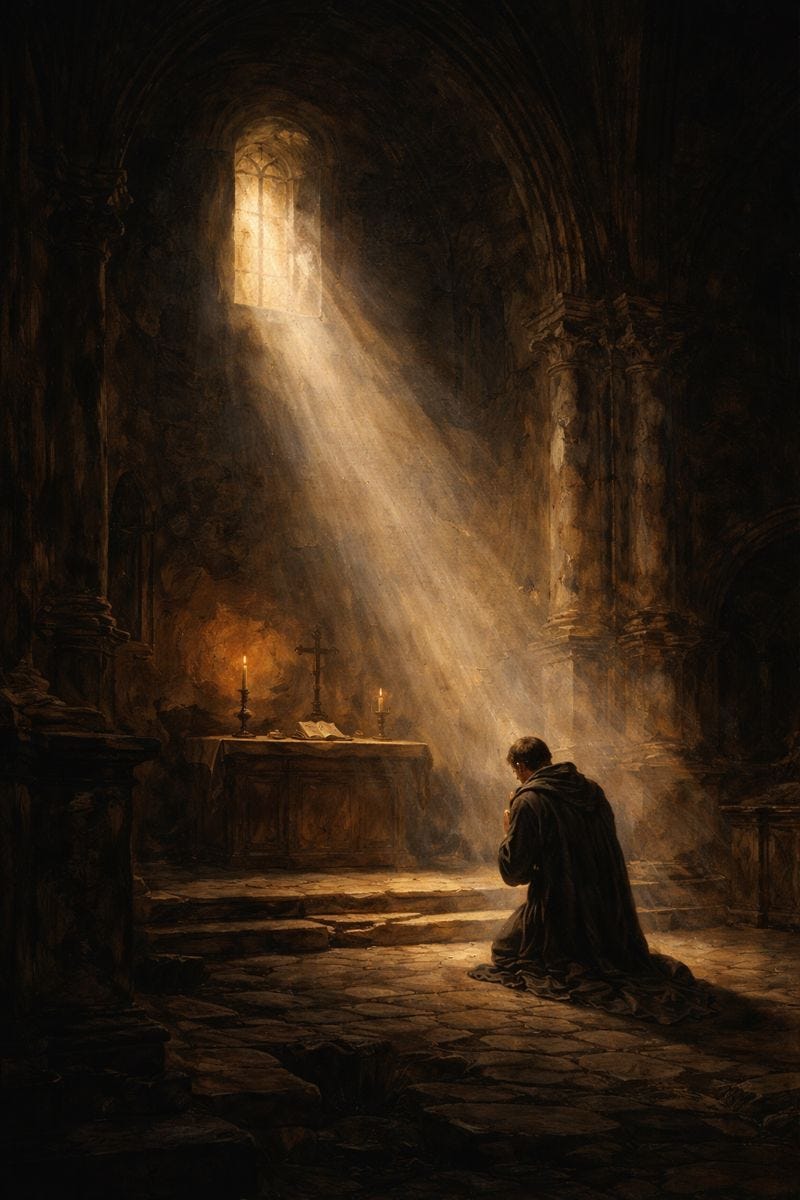
For those like myself, however, reason became the instrument through which the Spirit worked, not the means by which salvation was achieved. The intellectual revolution that occurred in me was not the replacement of one system with another. It was the collapse of a false reality. The world I had inhabited was structured by what thinkers such as Debord and Baudrillard describe as spectacle and simulation: appearances mistaken for substance, representations treated as reality, and meaning dissolved into performance.⁷ When faith finally came, it was not experienced as ecstasy or mystical presence. There were no visions, no voices, no altered states. Those things, far from being signs of true faith, often accompany misdirected faith or worse. True faith humbles. It brings a man to his knees. It does not inflate him.
That moment, when it came, was marked by peace. Not the absence of struggle, nor the resolution of every question, but the peace promised by Christ.⁸ When the angels proclaim “peace on earth,” they are not announcing a political program or a pacifist ideal, though restraint and justice among nations are always to be desired. They announce peace with God. They announce the end of enmity, the silencing of accusation, the assurance that judgment has been borne by another.
This world is not the place where faith is completed. It is the arena in which it is given. We do not, in the final analysis, find God. God finds us. Our agency in this is illusory. Faith is gift, not achievement. For those who have read this series carefully, you have followed my own movement from damnation to redemption, not as autobiography, but as testimony to the order of salvation as Scripture presents it.
This text is written for several readers. For those who, like me, did not receive simple faith at the beginning and whose minds demanded answers before they could kneel, I offer this path as witness, not prescription. For those already in the faith, I hope it strengthens assurance by clarifying foundations. For those who remain modern materialists, confident in man, reason, and progress, and for whom this journey will appear as one possibility among many, I can do only one thing. I will pray for you.
Faith is not having all the answers. It is surrendering to truths that reason cannot master and trusting a God who has acted decisively in Christ. The remainder of this article turns to that decisive act itself. Christ was not born merely to teach, inspire, or accompany humanity. He was born to die.
The Cross Already Present in the Manger
The Nativity cannot be understood on its own terms. When isolated from its end, it collapses into sentiment. A child in a manger invites tenderness, nostalgia, and projection. But Scripture does not present the birth of Christ as an open beginning whose meaning is supplied later by circumstance or tragedy. It presents the birth as ordered from the beginning toward death. Christ is not born into a neutral world in which events simply happen to Him. He is born for a purpose, and that purpose is execution.
This is the first scandal Christmas introduces and the first one modern sensibility works tirelessly to soften. Christ does not arrive as a figure who might succeed or fail depending on historical contingencies. He does not enter history to see how things unfold. He enters with His end already determined. The manger already contains the Cross. The wood that holds the infant anticipates the wood that will bear the man. This is not poetic hindsight. It is theological necessity.
Scripture makes this ordering explicit. Christ speaks of His death not as an interruption but as fulfillment. He moves steadily toward Jerusalem with full knowledge of what awaits Him.⁹ The Passion is not the derailment of a mission gone wrong. It is the mission itself coming into view. When He speaks of being “lifted up,” He is not predicting martyrdom but describing the means by which He will draw all men to Himself.¹⁰ The Cross is not imposed upon Him by history. It is embraced as the means appointed by the Father.
This purpose-driven birth distinguishes Christianity from every religious or moral system that treats suffering as accident, misfortune, or mere consequence. In Christ, suffering is assumed deliberately. He does not enter the human condition to observe it sympathetically from within. He enters to bear it, exhaust it, and bring it to judgment. The Incarnation is therefore not an end in itself. It is ordered toward atonement. Flesh is assumed so that flesh may be offered. Blood is taken so that blood may be poured out.
Modern attempts to recast the Cross as tragedy or miscarriage betray a fundamental misunderstanding of agency. Tragedy implies loss of control. Accident implies lack of intention. Neither category applies. Christ declares that no one takes His life from Him. He lays it down of His own accord.¹¹ The authority to lay it down and to take it up again belongs to Him precisely because He is not merely man acted upon by forces greater than Himself. He is the Son acting in obedience to the Father within the unity of the divine will.
This is why any reading of Christmas that does not already contain Good Friday is false. A Christ born merely to teach ethics would not require execution. A Christ born merely to inspire would not need a Cross. Only a Christ born to deal with sin must die. The Cross is not the price of speaking inconvenient truths to power. It is the price of bearing guilt that is not His own. The political authorities involved are real, but they are secondary. The primary transaction is not between Christ and Rome. It is between Christ and God.
Here the language of purpose must be handled carefully, lest it be mistaken for fatalism. Christ’s obedience is not mechanical submission to a script. It is willing self-giving. The Father does not coerce the Son. The Son offers Himself in love. This offering is not reducible to human categories of sacrifice because it originates within the eternal life of God. The obedience enacted in time reflects an eternal relation of love, not domination.¹²
The presence of the Cross within the Nativity also reframes the meaning of humility. Christ’s lowly birth is not a lesson in simplicity for its own sake. It is the beginning of self-emptying that will culminate in death. Poverty, obscurity, and vulnerability are not aesthetic choices. They are the conditions under which the Son enters a world ordered by sin and death in order to confront it without reservation. He does not arrive protected. He arrives exposed.
This exposure is already visible in the infancy narratives themselves. A king is born who must flee. A child is born under threat of massacre. Blood is shed around Him before His own blood is shed for all.¹³ The world reacts to His presence not with neutrality but with hostility. That hostility is not accidental. Light entering darkness provokes resistance. The Cross is not an unexpected reaction to a well-intentioned ministry. It is the inevitable collision between holiness and a fallen order.
To say that Christ was born to die is therefore not to reduce His life to a prelude. It is to assign His life its proper coherence. Every word He speaks, every healing He performs, every confrontation He enters presses toward the moment when He will bear sin fully and finally. Teaching without atonement would leave humanity instructed but condemned. Compassion without sacrifice would leave suffering observed but unresolved. The Cross gathers all that precedes it and gives it meaning.
Christmas, rightly understood, is therefore not the celebration of potential. It is the announcement of intent. God enters history not to test a possibility, but to accomplish redemption. The child born in Bethlehem is already the Lamb prepared for sacrifice.¹⁴ The question is no longer whether Christ will die, but what that death will accomplish. That question leads directly to the center of the Gospel and to the axis upon which redemption turns.
The Cross as the Axis of Redemption: Atonement, Justification, and Reconciliation
If the Nativity already contains the Cross, then the Cross must be understood not as an episode within redemption, but as its axis. Everything before moves toward it. Everything after flows from it. Christianity does not orbit an ethical vision, a moral teacher, or a spiritual experience. It turns on a single historical act in which sin is dealt with, judgment is satisfied, and reconciliation is accomplished.
At the heart of this act stands atonement, a term that modern theology often evacuates of substance by reducing it to metaphor. Scripture does not permit such reduction. Atonement is not the dramatization of divine empathy, nor is it the illustration of moral seriousness. It is the objective dealing with sin before God. Sin is not merely a human problem requiring education or reform. It is an offense against God that demands judgment. The Cross answers that demand, not by ignoring justice, but by fulfilling it.¹⁵
This fulfillment occurs through substitution. Christ does not die alongside sinners as an inspiring companion. He dies in their place. He bears guilt that is not His own. He assumes condemnation He does not deserve. The wrath Scripture speaks of is not divine temper or instability. It is God’s settled opposition to sin as that which destroys His creation. On the Cross, that opposition is not suspended. It is exhausted. The judgment that would fall upon humanity falls upon Christ.¹⁶
This is why attempts to reinterpret the Cross as merely exemplary fail at the most basic level. An example may instruct. It cannot absolve. A moral influence may move the will. It cannot silence accusation. Only substitution can reconcile because only substitution addresses the actual problem. The Cross is not primarily about changing how humanity feels about God. It is about changing humanity’s standing before God.
From atonement flows justification, which is not a secondary doctrine but the direct consequence of Christ’s completed work. Because sin has been borne and judgment satisfied, God can declare the sinner righteous without compromising His justice. Justification is not a process of becoming morally improved. It is a verdict pronounced on the basis of Christ’s obedience and sacrifice.¹⁷ The sinner does not stand justified because he has been inwardly transformed, but because Christ’s righteousness is credited to him.
This distinction is not technical. It is pastoral. If justification depended upon interior transformation, assurance would be impossible. The conscience would remain trapped in perpetual self-examination, measuring progress, detecting failure, and oscillating between pride and despair. By grounding justification entirely outside the self, Scripture anchors assurance in something finished. “It is finished” is not devotional language. It is legal declaration.¹⁸
Here the unity of Christ’s person and work becomes decisive. Only one who is truly God can bear infinite judgment. Only one who is truly man can bear it on behalf of humanity. The Cross presupposes the Incarnation and completes its purpose. The Son does not suffer as a detached deity wearing humanity temporarily. He suffers as the incarnate mediator whose obedience encompasses His entire life and culminates in death. The righteousness that justifies is not confined to the moment of crucifixion. It is the total obedience of Christ, active and passive, offered and fulfilled.¹⁹
From justification flows reconciliation, which must be carefully distinguished from modern notions of mutual compromise. Reconciliation in Scripture is not God and man meeting halfway. It is God reconciling man to Himself. The hostility is not symmetrical. God does not need to be reconciled morally. Man does. The Cross does not persuade God to be merciful. It enacts mercy in a way that preserves truth and justice.²⁰
This is why reconciliation produces peace rather than mere relief. Peace is not the absence of tension achieved by denial. It is the settled state that follows resolved judgment. When sin has been addressed and guilt removed, enmity ceases. The believer is no longer at odds with God, not because God has lowered His standard, but because that standard has been met in Christ.
Every attempt to separate these realities fractures the Gospel. Remove substitution and justification becomes incoherent. Remove justification and reconciliation becomes sentiment. Remove reconciliation and peace becomes illusion. The Cross holds them together because it is the place where God acts decisively, not symbolically.
The Cross is therefore not one truth among many within Christianity. It is the truth by which all others are measured. Christmas without the Cross becomes atmosphere. Teaching without the Cross becomes moralism. Compassion without the Cross becomes therapy. The Cross alone answers sin, grounds faith, and reconciles the world to God.
Yet even here the argument is not complete. If Christ dies and remains dead, atonement cannot be known, justification cannot be declared, and reconciliation cannot be received. The Cross demands a verdict. That verdict is rendered not by men, but by God Himself. The Resurrection is that verdict, and without it the axis collapses.
Why the Resurrection Is Not an Epilogue: God’s Judgment on the Cross
If the Cross is the axis of redemption, then the Resurrection is the divine verdict upon it. The Resurrection does not follow the Crucifixion as a comforting sequel or narrative uplift. It is not an appendix added to console disappointed disciples or to salvage a movement that might otherwise have collapsed. It is God’s public judgment on the work of the Son. Without it, the Cross remains ambiguous. With it, the Cross is declared sufficient, final, and victorious.
Modern sentimentality routinely misplaces the Resurrection by treating it as emotional compensation. The disciples grieve. Hope appears lost. God restores morale by raising Jesus from the dead. This framing is psychologically appealing, but theologically false. The Resurrection does not primarily address the feelings of the disciples. It addresses the meaning of the Cross before God. If Christ remains in the grave, then His death is indistinguishable from that of any other righteous martyr. Suffering alone proves nothing. Death alone redeems nothing.
Scripture is explicit on this point. “If Christ has not been raised, your faith is futile and you are still in your sins.”²¹ This is not rhetorical exaggeration. It is logical necessity. Atonement cannot be inferred from death alone. Substitution must be ratified. The Resurrection is that ratification. It is the Father’s declaration that the Son’s obedience has been accepted, that sin has been borne fully, and that judgment has been exhausted rather than merely endured.
The Resurrection therefore functions juridically. It is not merely that Jesus lives again. It is that He is vindicated. God overturns the human verdict rendered against Him. Rome condemns Him. Jewish religious authorities denounce Him. The grave appears to confirm their judgment. The Resurrection reverses it. God declares that the condemned One is righteous, and by declaring Him righteous, He declares righteous all who are united to Him by faith.²² Justification does not arise in a vacuum. It flows from this verdict.
This is why the Resurrection cannot be separated from justification. If Christ is raised, then His righteousness stands. If His righteousness stands, then it can be credited. If He is not raised, then death retains its claim, sin retains its power, and justification becomes fiction. The Gospel is not merely that Christ died for sins. It is that He was raised for our justification.²³ The Resurrection is not an optional affirmation of hope. It is the ground upon which faith rests.
The Resurrection also establishes the identity of Christ beyond dispute. Many have died unjustly. Many have been executed under false charges. None have been raised by God as a declaration of divine approval. The Resurrection is not merely an act of power. It is an act of identification. God identifies Jesus publicly as His Son and as Lord. The Cross, which appears as defeat, is revealed as obedience. The shame of execution is revealed as glory. The logic of the world is overturned, not by argument, but by act.
This overturning exposes a further modern evasion. When the Resurrection is reduced to symbol or interior experience, its judicial force is lost. A metaphorical resurrection may inspire. It cannot vindicate. An existential resurrection may encourage perseverance. It cannot declare righteousness. Only a real, bodily Resurrection can function as God’s verdict in history. This is why Scripture insists on physicality, witnesses, and continuity.²⁴ The risen Christ is not a memory, an idea, or a feeling. He is the same Christ who was crucified, now alive.
The Resurrection also prevents the Cross from being misinterpreted as divine cruelty. Without Resurrection, the Cross risks being read as the abandonment of the Son or the triumph of violence. With Resurrection, the Cross is revealed as self-giving love enacted within the unity of the Triune God. The Father does not rescue the Son from obedience. He receives that obedience and exalts Him because of it.²⁵ The Resurrection is therefore not a reversal of the Cross. It is its unveiling.
In this sense, the Resurrection is not an epilogue. An epilogue comments on what has already concluded. The Resurrection reopens history. It declares that death does not have the final word, not as consolation, but as fact. It announces that the age governed by sin and death has been breached from within. Something genuinely new has begun, not in idea, but in reality.
This is why Christmas collapses into myth without Easter, and Good Friday collapses into despair without Sunday. The Nativity announces God’s entrance into time. The Cross announces God’s judgment on sin. The Resurrection announces God’s judgment on death itself. Remove any one of these, and the Gospel disintegrates. Together, they form a single, coherent act of redemption, ordered, accomplished, and confirmed by God.
The Resurrection does not complete the story in the sense of closing it. It opens the horizon toward which history now moves. That horizon is not progress, enlightenment, or moral improvement. It is new creation. The final section turns to that reality and to the place the believer now occupies within it.
Victory, Vindication, and the Beginning of the New Creation
The Resurrection does not merely confirm what has already occurred. It inaugurates something that did not previously exist. Scripture speaks of Christ raised from the dead as “the firstfruits,” a term that cannot be spiritualized without distortion.²⁶ Firstfruits are not symbols. They are the initial, concrete manifestation of a harvest that follows in kind. The Resurrection is therefore not only God’s verdict on the Cross. It is the beginning of a new order of reality.
This new creation must be distinguished carefully from both metaphor and triumphalism. The Resurrection does not announce the immediate transformation of the world into visible righteousness, nor does it promise the abolition of suffering, injustice, or death within history as it now unfolds. What it announces is the decisive breach of death’s dominion. Death no longer governs reality as an absolute. It remains present, active, and feared, but it no longer reigns unchallenged. Its defeat has been accomplished, though its removal is not yet complete.
Here the Christian life must be situated correctly. Believers live between justification and glorification, between the completed work of Christ and its final public manifestation. This “already and not yet” is not a theoretical tension. It is the lived condition of faith. Justification is complete. Sanctification is real but unfinished. The body remains subject to decay. Sin continues to cling. The world remains disordered. The Resurrection does not deny these realities. It reorders them by placing them under a future that has already begun.
This is why sanctification must be handled without confusion. Growth in holiness is the necessary fruit of faith, but it is never the measure of salvation. If sanctification is mistaken for evidence that justifies, the believer is returned to anxiety. If sanctification is dismissed as irrelevant, faith is emptied of obedience. Scripture permits neither error. The new creation has begun in Christ, not in us. Our participation in it is derivative and incomplete.²⁷
The Resurrection also reframes suffering. It does not romanticize it, nor does it deny its weight. It locates suffering within a defeated order. Suffering is no longer proof of abandonment. Nor is it redemptive in itself. Christ’s suffering redeems. Ours testifies. It bears witness to a world that is passing away and to a life that is hidden with Christ until it is revealed.²⁸
This hiddenness is essential. The new creation does not arrive as spectacle. It does not overwhelm the senses or coerce belief. It is discerned by faith, not by sight. This guards against two perennial distortions. The first is despair, which assumes that because the world remains broken, Christ must not reign. The second is utopianism, which assumes that because Christ reigns, the world must now be perfected through human effort. Both errors arise from confusing the Resurrection with its final consummation.
The vindication of Christ in the Resurrection also carries a promise to those united to Him. Resurrection is not unique to Christ as an isolated miracle. It is representative. What God has done in Him, He will do in those who belong to Him. This promise is not grounded in human potential or spiritual evolution. It is grounded in union. “Because I live, you also will live.”²⁹ The logic is not moral imitation. It is participation.
This participation is already real, though not yet visible. Believers are said to have been raised with Christ even as they continue to live under the conditions of mortality.³⁰ This paradox does not signal confusion. It signals that identity now precedes experience. The believer’s life is no longer defined by what is seen, but by what has been promised and secured. Assurance does not rest on progress. It rests on Christ’s victory.
The Resurrection therefore reopens history, but not in the way modern optimism imagines. History is not given a second chance to perfect itself. It is given a final direction. The end toward which all things move has already appeared within time. New creation has entered the old, not as replacement, but as invasion. The world continues, but it does so under judgment and promise simultaneously.
This perspective preserves sobriety. Christians do not expect history to save itself, nor do they withdraw from it in resignation. They live within it as witnesses. Their hope is not that the structures of this age will finally succeed, but that the risen Christ will complete what He has begun. The Resurrection is not the climax of the Gospel in the sense of closure. It is the guarantee that closure is coming, and that it will be life, not death, that has the final word.
From this horizon flows the peace proclaimed at Christmas, the peace that does not depend upon circumstances, outcomes, or visible triumph. That peace must now be named clearly, lest it be confused with sentiment, politics, or wishful thinking.
Peace on Earth: What Christmas Peace Actually Means
The proclamation of peace at Christmas is among the most frequently repeated and least understood claims of the Christian faith. “Peace on earth” is invoked as aspiration, sentiment, or moral encouragement, often emptied of its theological content and repurposed as a vague hope for social harmony. In this form, it becomes either a platitude or a disappointment. History has never lacked for reminders that nations do not easily live at peace. If Christmas peace were merely a promise of political calm or universal pacifism, it would stand condemned by the record of history itself.
Scripture means something far more precise and far more demanding. The peace announced at the Nativity is not first horizontal. It is vertical. It is peace with God.³¹ It addresses not the instability of nations but the enmity between God and man produced by sin. Until that enmity is resolved, no durable peace can exist, whether personal or collective. The Gospel does not begin by soothing human anxiety. It begins by naming human guilt. Only when guilt is addressed can peace follow.
This distinction matters because modern man instinctively seeks peace without judgment. He wants reconciliation without truth, harmony without repentance, comfort without surrender. Christmas sentimentality feeds this desire by presenting peace as emotional reassurance detached from the Cross. But the angels’ proclamation cannot be severed from the sacrifice Christ is born to offer. The peace of Christmas flows directly from the atonement accomplished at Calvary and vindicated in the Resurrection. It is not declared because God has decided to overlook sin. It is declared because sin has been dealt with fully and finally.
Peace, in Christian terms, is therefore not a feeling, though it may give rise to one. It is a state of affairs. It is the condition of having one’s standing before God resolved. When Scripture speaks of peace, it speaks of consciences quieted, accusations silenced, and judgment borne by another.³² This peace is objective before it is experienced subjectively. One may feel anxious and yet be at peace with God. One may feel calm and yet remain under judgment. Feelings do not determine reality. Christ does.
This is why the peace Christ gives differs categorically from what the world offers. The world offers peace as the absence of disturbance. Christ offers peace in the presence of conflict. The world offers peace through control, security, or denial. Christ offers peace through reconciliation. “My peace I give to you. Not as the world gives do I give to you.”³³ The distinction is not rhetorical. It is ontological. Worldly peace depends upon conditions remaining favorable. Christian peace rests upon a finished work that does not change.
This peace also redefines the believer’s relationship to history. If peace were tied to the success of human projects, faith would rise and fall with circumstances. If peace were dependent upon visible progress, it would evaporate in the face of decline. Christian peace endures because it is anchored outside of history even as it operates within it. The believer does not expect the world to become safe in order to trust God. He trusts God because Christ has already secured peace where it mattered most.
This does not render concern for justice, restraint, or mercy among nations irrelevant. Scripture consistently calls for such things. But it places them in their proper order. They are fruits of faith, not its foundation. They are provisional goods, not ultimate ones. When peace is sought apart from Christ, it becomes either coercive or illusory. When peace flows from Christ, it remains even when external conditions deteriorate.
Here the question of agency must be addressed without evasion. Modern culture flatters itself with the belief that peace is something humanity constructs through moral insight, technological coordination, or political will. Christianity denies this premise. Peace is given, not built. We do not, in the final analysis, find God. God finds us.³⁴ Faith is not an achievement reached by clarity of thought or purity of intention. It is a gift bestowed by grace.
This denial of human agency offends modern sensibility because it strikes at the heart of autonomy. Yet it is precisely this denial that makes peace possible. If peace depended upon our capacity to sustain it, it would always be fragile. Because it depends upon Christ’s completed work, it is secure even when our faith wavers. The believer’s peace does not lie in the steadiness of his trust, but in the steadfastness of the One trusted.
The peace announced at Christmas therefore does not promise escape from struggle. It promises rest within it. It does not assure the believer that the world will conform to his hopes. It assures him that his standing before God does not depend upon the world’s verdict. This peace allows the Christian to live without illusion, without despair, and without the frantic need to justify himself.
For those who have come to faith through reason reordered by conviction, this peace often arrives not as exhilaration but as release. The endless labor of self-explanation ceases. The pressure to resolve every mystery lifts. Faith does not eliminate questions. It reorders them. Some are answered. Others are surrendered. To have faith is not to possess exhaustive understanding. It is to trust the One who does.
This peace stands as the final gift Christmas announces and the final gift the Cross secures. It prepares the believer not for mastery of life, but for endurance. And it sets the stage for the final word of the series, which must be spoken without triumphalism and without despair. Faith ends not in certainty of outcomes, but in surrender to Christ Himself.
Surrender, Mystery, and Prayer: The End of Reason and the Beginning of Faith
The movement traced in this series does not end in mastery. It ends in surrender. This must be stated without ambiguity, because modern man habitually mistakes faith for a superior form of explanation. He assumes that belief functions as an answer where reason fails, as though Christianity were a more ambitious system designed to resolve what science, philosophy, or psychology cannot. That assumption is false. Faith does not complete reason’s project. It judges it, orders it, and finally brings it to rest.
To come to faith is not to arrive at total clarity. It is to relinquish the demand for it. This does not mean abandoning reason or despising it. Reason remains a gift of God, but it is no longer enthroned. It is restored to its proper office. It serves rather than governs. It illuminates rather than commands. In my own case, the end of inquiry did not come through exhaustion of questions, but through recognition that the most important truths are not deduced but received. Faith begins where the illusion of control ends.
This surrender is not irrational. It is anti-autonomous. Modern autonomy insists that the self must remain sovereign, that nothing may stand above the judging subject. Christianity confronts this posture directly. The Gospel does not ask permission to be true. It announces what God has done and calls the hearer to repentance and trust. That call is not coercive, but it is absolute. One either receives what has been given or remains bound to the self as final authority.
Here the mystery of faith must be embraced rather than evaded. Mystery, in Christian theology, is not obscurity created by insufficient information. It is depth created by divine reality. God is not mysterious because He is hidden arbitrarily, but because He is inexhaustible. To demand that all things be rendered transparent to human understanding is not humility. It is a refusal to acknowledge creaturely limits. Faith does not dissolve mystery. It bows before it.
This bowing is not passive resignation. It is trust. Trust is not confidence in one’s own interpretive power. It is confidence in the character and promise of God revealed in Christ. The believer does not trust because all questions have been answered. He trusts because the One who answers has been given. This is why faith can coexist with uncertainty without collapsing into skepticism. The object of faith, not the strength of faith, sustains it.
At this point, the distinction between faith given simply and faith given through struggle must be reaffirmed without hierarchy. Those who receive childlike trust early are not less faithful. Those who arrive through long interrogation are not more faithful. Faith is faith because it is gift. The Holy Spirit distributes as He wills. Some are led quickly. Others are led through fire. The path does not determine the value of the gift. Christ alone does.
For those who have followed this series attentively, you have not merely traced arguments. You have followed a trajectory. You have moved from the question of God’s apparent absence, through the necessity of an inerrant Word, through the meaning of Incarnation, Cross, and Resurrection, and finally to the peace that faith alone provides. If you have recognized yourself somewhere in that movement, then the series has served its purpose. Not by persuading you, but by clearing space for the Holy Spirit to act.
For those already grounded in the faith, I offer this not as correction but as reinforcement. Faith is assaulted relentlessly in an age that worships spectacle, novelty, and self-assertion. To see faith from another angle is sometimes to see it anew. Assurance does not require novelty. It requires remembrance.
For those who remain unmoved, untouched, or unconvinced, I offer no further argument. Argument has its place, but it cannot generate faith. I will do the only thing that remains within my calling. I will pray for you. Not with presumption, and not with despair, but with trust that God’s mercy is not constrained by my words or your resistance. Whether all are meant to receive this gift, I do not know. Scripture does not grant me that knowledge. To have faith is to live within that limit without bitterness.
The Christian confession does not end with intellectual resolution. It ends with Christ. He is not one answer among many. He is the end of the question itself. Born to die. Raised to reign. Present not as idea or influence, but as Lord.
This is where reason rests.
This is where faith begins.
Footnotes
Romans 3:19–20. The Law speaks “so that every mouth may be stopped,” establishing conviction as judgment rather than persuasion.
Romans 3:21–26; Romans 4:5. Justification as forensic declaration grounded in Christ’s righteousness.
Ephesians 2:8–9; Galatians 2:16. Salvation by grace through faith apart from works of the Law.
Romans 6:3–5; Galatians 3:27. Baptism as participation in Christ’s death and resurrection.
Philippians 1:6; Romans 7:14–25. Sanctification real yet incomplete in this life.
Matthew 18:3; Mark 10:15. Christ’s commendation of childlike faith.
Guy Debord, The Society of the Spectacle; Jean Baudrillard, Simulacra and Simulation. Modernity’s displacement of reality by representation.
John 14:27; Romans 5:1. Peace grounded in reconciliation with God through Christ.
Luke 9:51. Christ’s deliberate movement toward Jerusalem and the Passion.
John 12:32–33. Christ’s self-identification of His death as the means of drawing all to Himself.
John 10:17–18. Christ’s authority to lay down His life and take it up again.
Philippians 2:6–8. Obedience as self-giving within the eternal relation of the Son to the Father.
Matthew 2:13–18. Early hostility surrounding the Nativity, foreshadowing the Cross.
Revelation 13:8. The Lamb “slain from the foundation of the world,” indicating eternal purpose.
Isaiah 53:5–6; Romans 8:3. Atonement as objective dealing with sin.
Galatians 3:13; 2 Corinthians 5:21. Substitution and the bearing of judgment by Christ.
Romans 5:18–19. Justification as verdict grounded in Christ’s obedience.
John 19:30. Finality of Christ’s atoning work.
Romans 5:19; Hebrews 5:8–9. The unity of Christ’s active and passive obedience.
Colossians 1:20; Romans 5:10. Reconciliation as God’s act toward humanity.
1 Corinthians 15:17. The Resurrection as necessary for the validity of faith.
Acts 2:36; Romans 1:4. Resurrection as divine vindication of Christ’s identity.
Romans 4:25. Christ raised “for our justification.”
Luke 24:36–43; John 20:27. Bodily Resurrection affirmed against spiritualization.
Philippians 2:9–11. Exaltation following obedience unto death.
1 Corinthians 15:20–23. Resurrection as firstfruits of the new creation.
Galatians 5:22–23; Romans 8:10–11. Sanctification as fruit, not ground, of salvation.
Colossians 3:1–4; Romans 8:18. Suffering located within a defeated order.
John 14:19. Union with the living Christ as the basis of future resurrection.
Ephesians 2:5–6; Colossians 2:12. Present participation in Christ’s resurrection life.
Romans 5:1. Peace defined as reconciliation with God.
Hebrews 10:22. Conscience cleansed through Christ’s sacrifice.
John 14:27. Christ’s peace distinguished from worldly peace.
John 6:44; Ephesians 2:1–5. Divine initiative in bringing sinners to faith.